[et_pb_section fb_built=”1″ _builder_version=”4.27.4″ _module_preset=”default” global_colors_info=”{}” theme_builder_area=”post_content”][et_pb_row _builder_version=”4.27.4″ _module_preset=”default” global_colors_info=”{}” theme_builder_area=”post_content”][et_pb_column type=”4_4″ _builder_version=”4.27.4″ _module_preset=”default” global_colors_info=”{}” theme_builder_area=”post_content”][et_pb_text _builder_version=”4.27.4″ _module_preset=”default” hover_enabled=”0″ global_colors_info=”{}” theme_builder_area=”post_content” sticky_enabled=”0″]
7 Proven Strategies that actually work in 2025
Your website gets visitors, but not enough. You’re creating content, but it’s not ranking. You’re investing time and resources, but the organic traffic numbers remain stubbornly low.
Sound familiar?
You’re not alone. With 66.5% of content marketers now operating in hyper-competitive industries—up from 54.7% in 2024—getting noticed online has become brutal. Add AI-generated content flooding search results, and the challenge becomes even more daunting.
But here’s what most businesses miss: while everyone’s fighting over the same crowded spaces, massive opportunities exist for those who know where to look and how to execute properly
The Hidden Opportunity in Organic Traffic
Consider this: 46% of all Google searches have local intent, yet most businesses completely botch their local optimization. Local SEO delivers an average 748% ROI over three years, but only when done correctly.
The businesses winning in 2025 aren’t necessarily those with the biggest budgets—they’re the ones implementing proven strategies systematically. They understand that organic traffic growth requires both immediate tactical wins and long-term strategic thinking.
7 Proven Strategies to Increase Your Organic Traffic
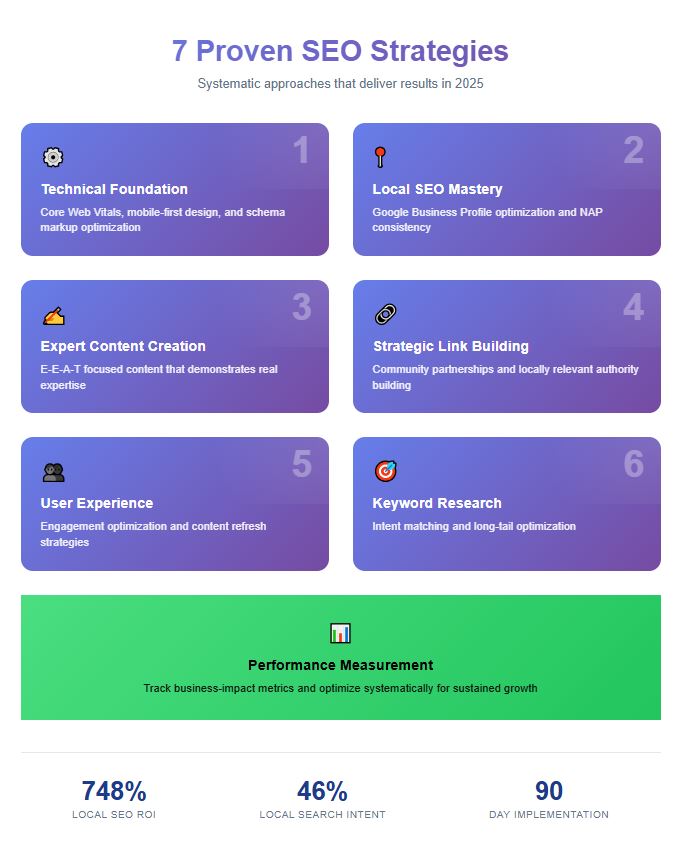
Strategy 1: Build an Unshakeable Technical Foundation
Your technical setup determines whether search engines can properly crawl, understand, and rank your content. Get this wrong, and even brilliant content won’t rank.
Core Web Vitals Optimization Only 47% of websites pass Core Web Vitals assessments, creating massive opportunity for businesses that prioritize performance. Focus on:
Largest Contentful Paint (LCP): Target under 2.5 seconds by compressing images to WebP format and removing unnecessary third-party scripts
Interaction to Next Paint (INP): Minimize JavaScript execution time and remove unused plugins for under 200 milliseconds
Cumulative Layout Shift (CLS): Prevent unexpected layout changes that frustrate users
Mobile-First Requirements With Google’s mobile-first indexing, your mobile version determines rankings:
Implement responsive design with flexible grid layouts
Ensure text remains readable without horizontal scrolling
Optimize touch targets to minimum 44px
Add click-to-call functionality for phone numbers
Essential Schema Markup Help search engines understand your content with structured data:
Implement LocalBusiness schema using JSON-LD format
Include required properties: business name, address, telephone, operating hours
Add FAQ schema for common customer questions
Use industry-specific schema subtypes when available
Strategy 2: Master Local SEO for Maximum Visibility
Local optimization offers the highest ROI potential, yet most businesses leave massive gains on the table through poor execution.
Google Business Profile Optimization Your Google Business Profile serves as your local search headquarters:
Complete all profile sections—fully complete profiles see 97% better performance
Upload 10-15 high-quality photos featuring local context
Select primary category plus up to 9 additional relevant categories
Maintain weekly Google Posts with varied content types
NAP Consistency Strategy Inconsistent citations plague 33% of small businesses and directly undermine local authority:
Audit and standardize Name, Address, Phone information across all platforms
Use identical formatting everywhere (don’t mix “Street” and “St.”)
Submit to top 10 local directories prioritizing quality over quantity
Monitor citations monthly and address inconsistencies immediately
Review Acquisition System Reviews significantly impact local rankings, with 89% of consumers preferring businesses that respond within 24-48 hours:
Launch systematic review requests immediately after positive interactions
Provide direct links to review platforms
Follow up with gentle email reminders
Respond to all reviews professionally and promptly
Strategy 3: Create Content That Demonstrates Expertise
With AI-generated content saturating search results, authentic expertise becomes your competitive advantage. Google’s E-E-A-T requirements (Experience, Expertise, Authoritativeness, Trustworthiness) reward genuine knowledge and authentic perspectives.
High-Performance Content Types
Location-specific service pages: Outperform generic alternatives by including local landmarks and community events
Customer success stories: Film in recognizable local settings for powerful social proof
Behind-the-scenes content: Feature staff with local connections to humanize your brand
Industry insights: Share expertise on local business conditions and economic developments
Content Strategy Framework Implement a 70/30 approach:
70% short-form content (400-800 words): Regular engagement and social sharing
30% long-form content (1,500+ words): Authority building and backlink attraction
Transform customer interactions into content:
Customer service questions → FAQ content
Project photos → before/after blog posts
Staff expertise → local industry insight articles
Addressing Search Intent Target neighborhood names, regional landmarks, and local colloquialisms alongside traditional service+location combinations. Structure content to answer voice search queries with conversational language, as 60% of local searches occur on mobile devices.
Strategy 4: Build Authority Through Strategic Link Building
Focus on locally relevant authority rather than pursuing irrelevant high-DA links. Quality trumps quantity every time.
Community-Based Opportunities
Partner with local nonprofits and charities through sponsorships or volunteer services
Build relationships with educational institutions through scholarship programs or guest speaking
Exchange testimonials with vendors and service providers you use
Content-Driven Link Earning Create linkable assets specifically for your local market:
Comprehensive local guides and market research
Industry statistics relevant to your area
Case studies featuring recognizable local projects
Resource pages serving the broader business community
Local Business Collaboration
Develop partnerships with complementary businesses serving similar customers
Create joint content and cross-promotional campaigns
Share event sponsorships and community involvement
Strategy 5: Optimize User Experience for Engagement
Search engines reward websites that users find valuable and engaging. Focus on metrics that indicate genuine user satisfaction.
Engagement Optimization
Reduce bounce rate by improving page load speed and matching content to search intent
Increase time on page through compelling introductions and clear content structure
Improve click-through rates with compelling titles and meta descriptions
Create internal linking pathways that guide users to related valuable content
Content Refresh Strategy
Update evergreen content regularly with new information and examples
Add current statistics and recent case studies to existing articles
Refresh outdated screenshots and examples
Expand successful content with additional sections and insights
Strategy 6: Master Keyword Research and Intent Matching
Effective keyword research goes beyond search volume—it’s about understanding and matching user intent.
Intent-Based Research Use these sources for authentic keyword discovery:
Google Business Profile Insights to identify actual search terms customers use
Google Autocomplete and “People Also Ask” sections for local suggestions
Customer service questions and support tickets
Sales team feedback on common customer language
Long-Tail Optimization Target specific, intent-rich phrases:
“winter pipe maintenance in Minneapolis” vs. generic “plumbing services”
“commercial plumbing regulations in downtown Seattle” vs. “commercial plumbing”
Include question-based keywords that match voice search patterns
Competitive Intelligence
Analyze competitors’ keyword strategies and identify gaps
Research which content types perform best in your industry
Monitor competitor backlink strategies and community involvement
Strategy 7: Measure Performance and Optimize Systematically
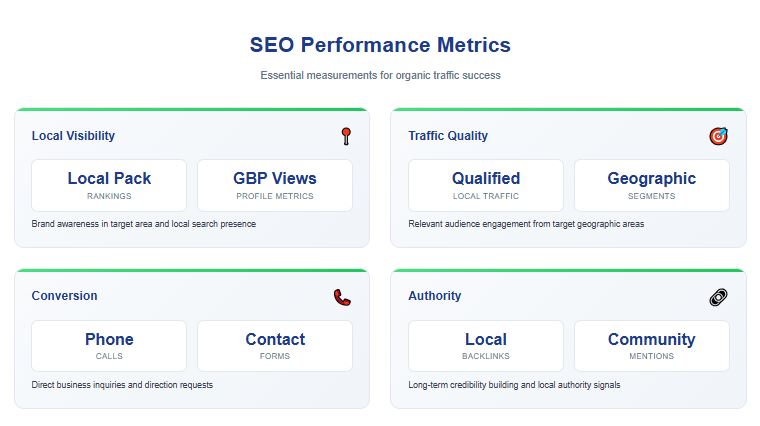
Track business-impact metrics rather than vanity statistics. Focus on measurements that directly correlate with revenue and growth.
Essential Metrics to Track
Free Tool Stack Start with Google’s comprehensive toolkit:
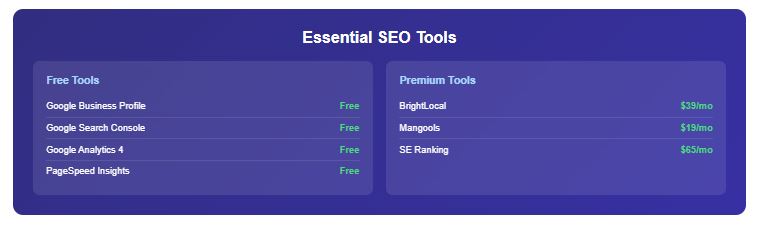
Google Business Profile for local presence management
Google Search Console for search performance monitoring
Google Analytics 4 for traffic analysis with geographic segments
Google PageSpeed Insights for technical optimization guidance
Strategic Paid Tool Investments For monthly budgets of $30-50, prioritize tools with local-specific features:
BrightLocal ($39/month): Local rank tracking and citation management
Mangools ($19/month): Beginner-friendly keyword research and rank tracking
SE Ranking ($65/month): Comprehensive local SEO with white-label reporting
Your 90-Day Implementation Roadmap
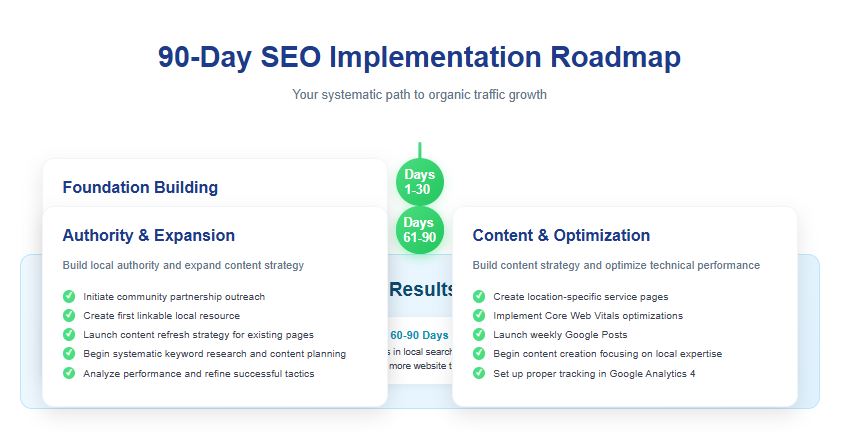
Days 1-30: Foundation Building
Claim and optimize Google Business Profile completely
Audit and standardize NAP information across all platforms
Implement basic LocalBusiness schema markup
Submit to top 10 local directories
Begin systematic review request process
Days 31-60: Content and Optimization
Create location-specific service pages
Implement Core Web Vitals optimizations
Launch weekly Google Posts
Begin content creation focusing on local expertise
Set up proper tracking in Google Analytics 4
Days 61-90: Authority and Expansion
Initiate community partnership outreach
Create first linkable local resource
Launch content refresh strategy for existing pages
Begin systematic keyword research and content planning
Analyze performance and refine successful tactics
Expected Results and Timeline
Businesses implementing these strategies systematically can expect:
30-60 Days:
15-25% improvements in local pack visibility
Increased Google Business Profile views and actions
Better Core Web Vitals scores 60-90 Days:
30-50% increases in local search visibility
10-20% increases in website traffic from local searches
Improved click-through rates from search results
6-12 Months:
Positive ROI becomes evident
Sustained organic traffic growth
Established local authority and community recognition 2-3 Years:
Peak performance in local search results
Compound growth from authority building
Exceptional ROI justifying continued investment
Common Mistakes That Kill Results
Foundational Errors:
Incomplete or inconsistent business information (affects 33% of small businesses)
Neglecting mobile optimization when 60% of local searches are mobile
Creating generic content without local relevance
Poor review management and slow response times
Measurement Mistakes:
Focusing on traffic volume without measuring qualified conversions
Using last-click attribution instead of multi-touch models
Tracking vanity metrics instead of business-impact measurements
Failing to segment geographic traffic for local performance analysis
Start Growing Your Organic Traffic Today
Organic traffic growth isn’t about quick tricks or growth hacks—it’s about systematically implementing proven strategies that build sustainable competitive advantages.
The businesses dominating search results in 2025 understand that SEO isn’t just about rankings. It’s about becoming an integral, trusted part of your community while providing genuine value that search engines and users both recognize and reward.
Start with your technical foundation, optimize for local visibility, create content that demonstrates real expertise, and measure what matters. Small, consistent improvements compound into significant competitive advantages that deliver exceptional ROI for years to come.
Ready to transform your organic traffic? Pick one strategy from this guide, implement it completely, and measure the results. Success builds momentum, and momentum builds sustainable growth.
[/et_pb_text][/et_pb_column][/et_pb_row][/et_pb_section]